Business Automation

AI does the work. Rules keep it honest.

Every operation runs on work nobody sees: numbers re-typed from one system into another, reports assembled every Friday, the same email written after every incident. AI can do this work now. The hard part is trusting it. Geigyr builds automation where every AI agent has a scoped job, every output is checked before it matters, and every run leaves a record, and we stay responsible for keeping it all running. Not a pile of scripts you inherit.

Work that follows rules today. Judgment calls with a human in the loop.

Documentation chains

Event to corrective action to sign-off to filed report, with a timestamp at every step. The pattern behind our compliance monitoring, applied to whatever your operation has to prove: incidents, inspections, maintenance, training records.

Alert routing with context

The right person gets the message, with what happened, where, for how long, and what to check, instead of an inbox alarm forty people ignore. Escalation when nobody responds. Quiet when nothing is wrong.

Systems that finally talk

Sensor platforms, ERP, quality systems, spreadsheets, email, all connected so information entered once shows up everywhere it is needed. The re-typing stops, and so do the transcription errors.

Recurring reports

The Friday production summary, the weekly compliance log, the monthly numbers for insurance, assembled from live data and delivered on schedule. Nobody spends Thursday night in a spreadsheet.

AI agents, supervised

Where the work takes reading and judgment, an AI agent produces the draft and a person approves it: a deviation report from sensor data and your own SOPs, triage of inbound requests, a summary of a shift's events. The judgment stays yours; the blank page goes away.

Operational data pipelines

Getting operational data into a real analytics platform, and getting answers back out: downtime patterns, quality trends, equipment behavior before it fails. For operations ready to go past dashboards, we build on enterprise data platforms we have run for years.

We automate the workflow you actually have. Then we run it.

1

Map the real workflow

We sit with the people who do the work and write down what actually happens, including the workarounds, the exceptions, and the step everyone does differently. Automating a workflow nobody follows is how these projects fail.

2

Build it, prove it

The automation runs alongside the manual process until it has earned trust: same inputs, same outputs, verified. Then the manual step retires. Nothing is switched over on faith.

3

Run it as a service

Workflows break when vendors change an API, a form gets a new field, a certificate expires. We monitor the automation itself, fix what breaks, and adjust as your operation changes. You get an outcome, not a maintenance burden.

We run this pattern ourselves, every day.

One of our own properties is a daily online publication produced end to end by this architecture. Scheduled collectors pull from dozens of sources each morning. An AI editor reviews the pool and picks what runs. A second agent writes the headlines and lays out the page. A vision model checks the artwork before anything ships.

Each agent has one scoped job; rule-based workflows connect them, check every output against hard limits, fall back safely when something misfires, and log every run. It has published on schedule for months, with a human watching the notifications instead of doing the work. When we say AI can be made dependable, this is what we mean.
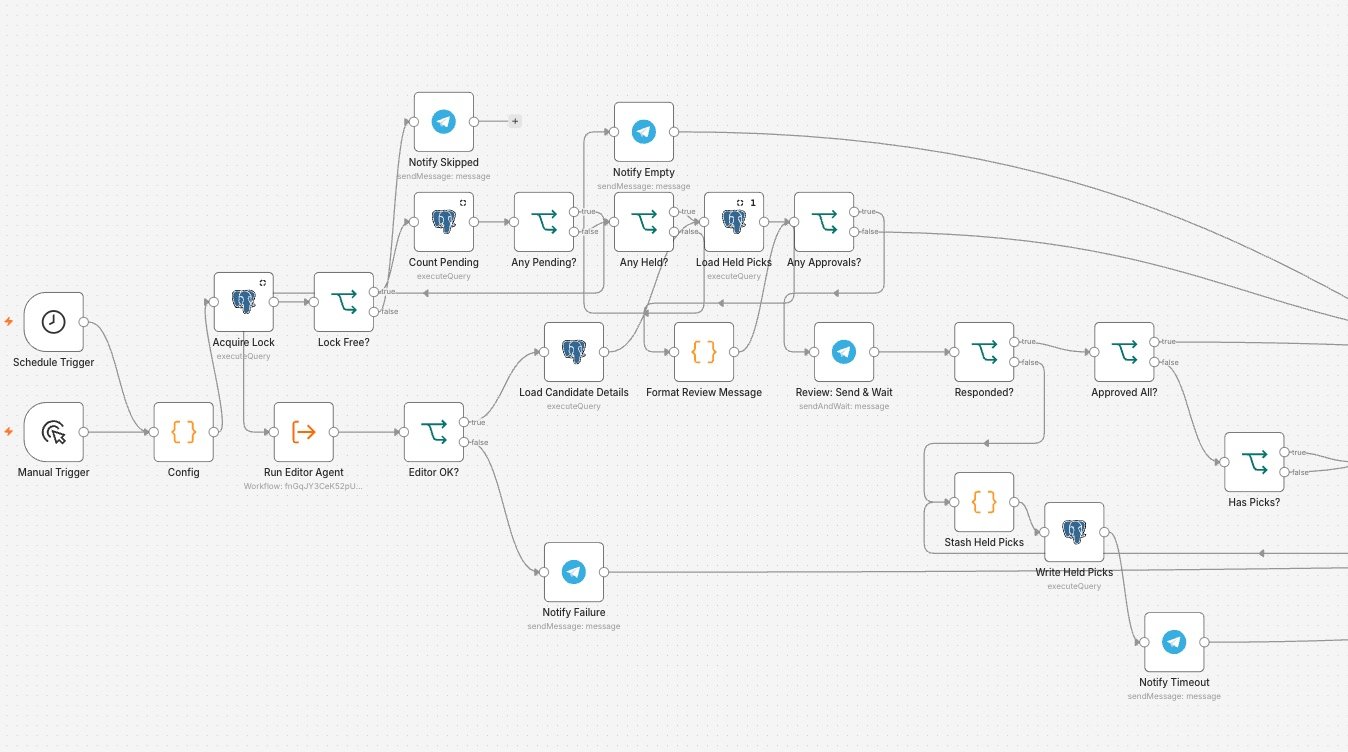
Production automation workflow with an AI editor agent, human review step, held-pick handling, and error notifications

The pipeline: scoped agents, rule-based checks, logged runs

Automation you can defend to an auditor.

Deterministic where it counts.

Anything that lands in a compliance record runs on rule-based workflows: same input, same output, every time. AI drafts and summarizes; it does not write your audit trail.

A person approves what matters.

Any step with real consequences waits for a named human to review and sign: a disposition, a customer message, a filed report. The automation prepares the decision; it does not make it.

Everything leaves a record.

Every run is logged: what came in, what went out, who approved it, when. Six months later you can answer "why did the system do that?" with a timestamped trail, not a shrug.

Built on proven tools, owned by you.

We build on established workflow and data platforms, the same stack that runs our monitoring service, under your accounts, on your data. If we part ways, the automation is yours, documented.

What eats an hour of somebody's day, every day?

Start there. Tell us about the report, the re-typing, or the paper form, and we'll tell you honestly whether automating it is worth the money.

Describe your process →
(732) 655-4340[email protected]